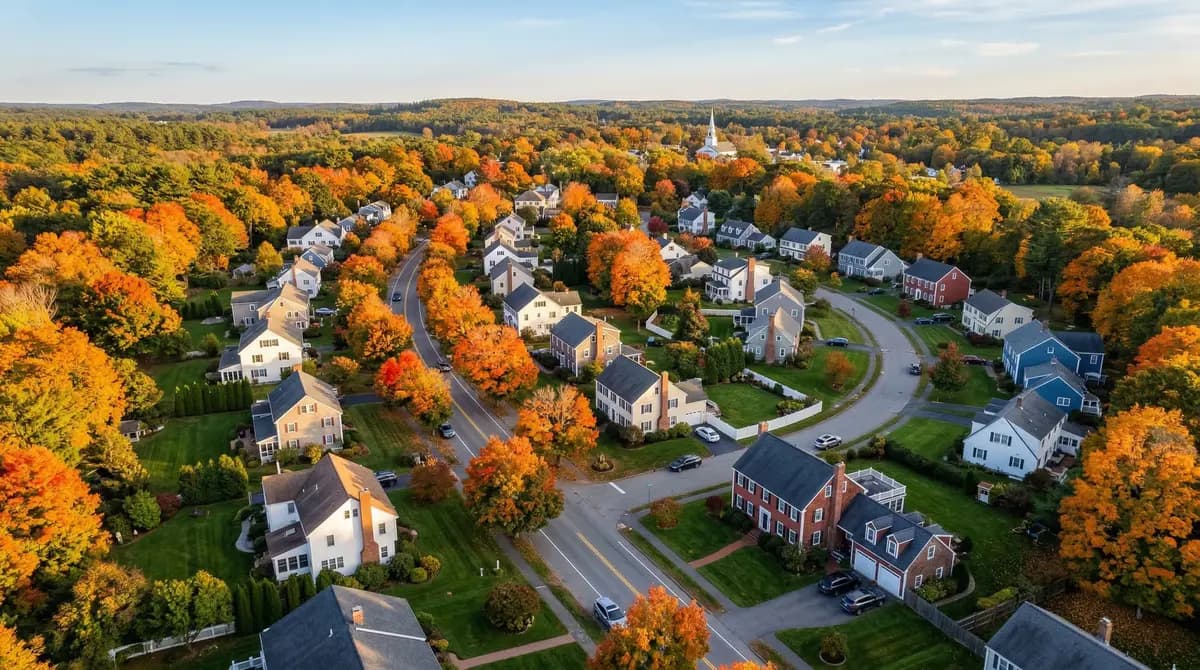
Canton and Sharon sit next to each other on the Providence/Stoughton commuter rail line, share a town border, and show up on the same shortlist for almost every school-focused buyer moving south of Boston. From the outside they look interchangeable: strong districts, 25-to-35-minute trains to South Station, home prices in the high $700s to high $800s. Spend a week touring both and the differences get sharp fast.
The single biggest one is the property tax bill. Canton's FY2026 residential rate is $9.75 per $1,000 of assessed value — one of the lowest in Norfolk County. Sharon's is $17.15, among the higher rates in the area. On similar houses, that is a difference of thousands of dollars every single year, and it is not an accident on either side. This post walks through where that gap comes from, what each town gives you in return, and how the schools, commutes, housing markets, and day-to-day lifestyle actually compare.
The quick verdict
If you want the lower monthly carrying cost, faster highway access, and a town with restaurants and retail woven into it, pick Canton. Its commercial base along Route 128/I-95 lets residents pay a $9.75 tax rate, and Canton Junction gets you to South Station in roughly 25 minutes.
If a lake-centered small town matters more to you than the tax bill, pick Sharon. The town wraps around a 392-acre lake with town beaches, and the trade is a $17.15 tax rate on a nearly all-residential tax base. Both are good outcomes — the right answer depends on how much weight your budget gives the tax line.
Schools: two districts of similar size
Both towns run their own districts from prekindergarten through grade 12, and they are close in size. For 2025-26 the state counts 3,401 students in Sharon Public Schools, with a student-to-teacher ratio of 13.3 to 1, and 3,314 students in Canton Public Schools, with a ratio of 12.6 to 1.
This guide does not rank the two districts. The state publishes test results, graduation rates, course offerings and staffing for every school on its School and District Profiles site, and both districts post their program of studies. Compare the grades and programs that matter to you, and visit both.
Taxes: $9.75 vs. $17.15 — and what each rate actually buys
This is the sharpest contrast between the two towns. For FY2026, Canton's residential tax rate is $9.75 per $1,000 of assessed value. Sharon's is $17.15 — both per Massachusetts DLS certified rates. Do the math on real numbers: at Zillow's current average home values, a typical Canton home around $806,000 carries an annual tax bill near $7,860, while a typical Sharon home around $889,000 carries a bill near $15,240. That is roughly a $7,400-per-year difference, or about $615 a month before you've bought a single upgrade in either house.
Why the gap? Structure, not mismanagement. Canton runs a split tax rate: residents pay $9.75, but commercial and industrial property pays $19.67. Canton has a lot of commercial property to tax — office parks, industrial space, and retail stacked along the Route 128/I-95 corridor — so businesses shoulder a meaningful share of the levy and homeowners get a break. Sharon made the opposite choice decades ago: it is a deliberately residential town with very little commercial base, so homeowners fund nearly the entire town budget themselves, schools included.
One honest caveat that applies to every town comparison: a tax rate is not a tax bill. Rates only mean something multiplied against assessed values, and a high-rate town with modest values can bill less than a low-rate town with expensive homes. In this particular matchup, though, both arrows point the same way — Sharon has the higher rate and the higher values, so Sharon bills are genuinely, materially higher. If you want to see where both towns fall against the rest of the region, I keep a full table in my FY2026 Massachusetts property tax rates by town guide.
The commute: same line, six minutes apart
Both towns ride the MBTA Providence/Stoughton Line into South Station, and the difference between them is small. On a current weekday schedule, a train leaving South Station at 6:22 p.m. reaches Canton Junction at 6:47 and Sharon at 6:53 — call it roughly 25 minutes to Canton and just over 30 to Sharon. Canton Junction has the added advantage of sitting at the fork of the line, so both Providence-branch and Stoughton-branch trains stop there, which means more departures to choose from; Canton also has a second station, Canton Center, on the Stoughton branch. Sharon's station is a single stop but a serious commuter operation, with 546 parking spaces and about 756 daily boardings as of 2024.
Drivers should weight this section differently. Canton has direct access to Route 128/I-95 and I-93, which makes it one of the best highway-positioned towns south of Boston — a real factor if one of you commutes to the 128 belt rather than downtown. Sharon sits a few miles further from the interchanges via Route 27 or I-95's Sharon exits. Neither commute is a problem; Canton's is simply more flexible.
Housing and home values
Sharon is the more expensive market of the two. As of spring 2026, Redfin puts Sharon's median sale price at about $858,000, up 4 percent year over year, and Zillow's average home value for the town is about $889,000 — with homes going pending in around nine days. That last number is worth sitting with: nine days to pending means well-priced Sharon listings are effectively decided in one weekend of showings.
Canton comes in meaningfully lower: Zillow's average value is about $806,000, up 2.1 percent over the past year, and Redfin's median sale price is around $730,000. Canton's housing stock is also more varied — alongside the colonials and capes you'll find substantial condo and townhouse inventory, which gives buyers an entry point in the $400s-$500s that barely exists in Sharon. Sharon's stock skews single-family on larger lots, much of it 1960s-80s construction in quiet neighborhoods, with the premium streets clustered near Lake Massapoag. Rough rule of thumb from the numbers above: expect to pay somewhere around $80,000-$130,000 more for the comparable house in Sharon, and then pay roughly double the property tax on it each year.
Lifestyle: Blue Hills vs. Lake Massapoag
Canton's backyard is the Blue Hills Reservation — 7,000 acres of DCR land with 125 miles of trails and Great Blue Hill, the 635-foot high point of the chain, right at the town's edge. Hiking, mountain biking, and Ponkapoag Pond are effectively neighborhood amenities on Canton's north side. Canton also functions more like a full-service town: Washington Street's downtown, the retail and restaurants that come with a commercial tax base, and quick access to everything along Route 128. It feels busier because it is busier — that's the same commercial activity that's keeping your tax rate at $9.75.
Sharon's identity is the lake. Lake Massapoag is a 392-acre spring-fed lake with town beaches, sailing, and summer recreation programs, and it shapes the town's social calendar the way a downtown shapes other towns'. Beyond the lake, Sharon is notably green — Mass Audubon's Moose Hill Wildlife Sanctuary anchors a large belt of conserved land — and notably quiet, with a small town center and little commercial strip development. If your ideal Saturday is a trailhead, Canton delivers; if it's a beach chair on a lake, Sharon does.
Who should pick which
Pick Canton if the monthly number drives the decision. The lower purchase prices, the $9.75 tax rate, condo options for a first purchase, more train departures, and direct highway access add up to genuinely lower cost and friction. Canton is the pragmatist's answer.
Pick Sharon if the lake and a quiet, mostly residential town are the point of the move and the budget can absorb it. You are paying more twice — on price and on taxes — and you're getting a lake-centered small town with its own commuter rail station. Either way, run the full monthly cost — mortgage, taxes, insurance — on real listings in both towns before you commit to a search area; the tax delta changes what price band you can shop. My buyer's guide walks through exactly how I structure that, and if you want the two-town tour in person, reach out — I show homes in both every month.
There is no wrong answer between Canton and Sharon — they are two of the strongest towns in Norfolk County, and the honest comparison is about which trade-offs fit your budget and priorities, not which town is "better." The tax structure is the piece most buyers discover too late, so run those numbers first.
I'm Jessica Shauffer with the Weinstein Keach Group at Coldwell Banker Realty, a Presidents Circle agent (top 3 percent company-wide) working across Norfolk and Bristol counties. If you're weighing Canton against Sharon — or either against Easton, Mansfield, or Stoughton — call me at (617) 949-1046 and I'll help you compare them on real listings, not averages.
Ready to Make a Move?
Jessica Shauffer is a top Coldwell Banker agent serving Easton, Attleboro, Mansfield, and 22 other South Shore communities. Get a free consultation today.