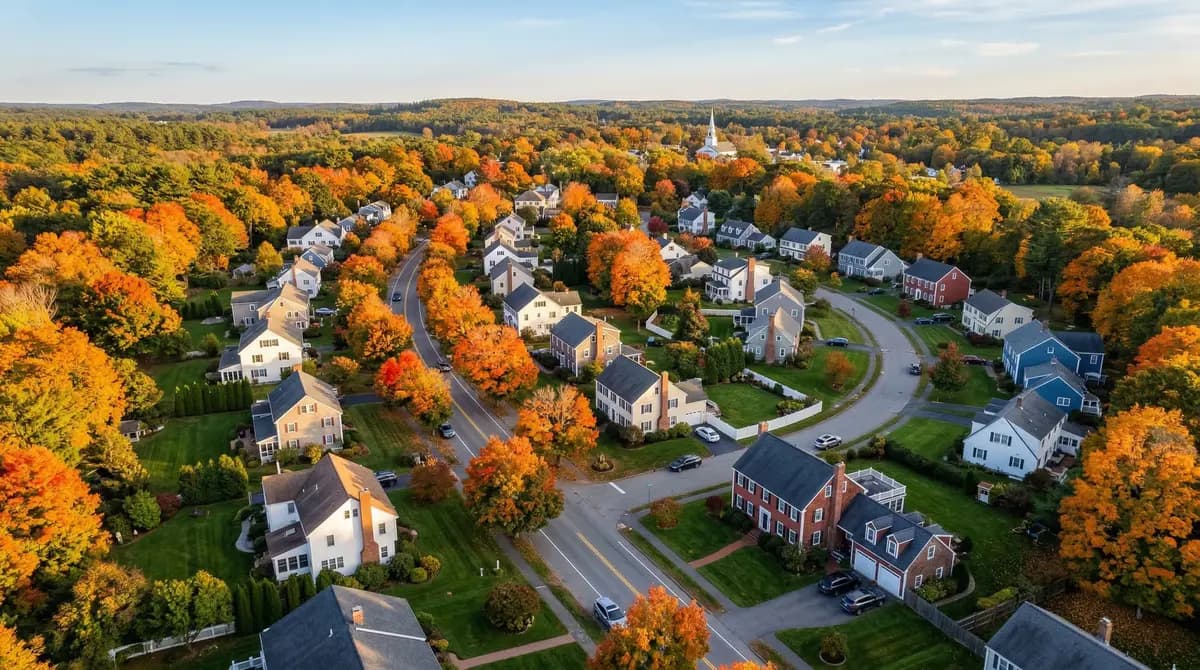
Easton and Mansfield sit next door to each other in northern Bristol County, share a border along Route 106, and compete for many of the same buyers. On paper they look interchangeable. They are not.
The short version: Mansfield is the commuter's town, built around one of the busiest commuter rail stations outside Boston. Easton is the character town — historic villages, protected open space, and a downtown in North Easton that Mansfield genuinely can't match. Both school systems are strong enough that schools alone probably shouldn't decide this for you.
I live and work in South Easton and sell in both towns, so what follows is the comparison I actually walk buyers through — with verified numbers, not vibes.
The Quick Verdict
If you only read one section, here's the head-to-head.
Schools: Both towns run their own PK-12 districts of similar size: about 3,300 students in Easton and 3,200 in Mansfield for 2025-26, per the state.
Commute: Mansfield, and it isn't close. Mansfield has its own MBTA station on the Providence/Stoughton Line with trains reaching South Station in roughly 39 to 44 minutes. Easton has no train station at all — you're driving to Stoughton or Mansfield to catch one.
Property taxes: Easton wins on rate. Easton's FY2026 residential rate is $12.59 per $1,000 versus Mansfield's $13.09. On a $650,000 home that's a difference of about $325 a year — real, but not decisive. The full picture is in my FY2026 Massachusetts property tax rate guide.
Home styles and values: Easton's typical home value is about $696,000 and Mansfield's about $715,000 (Zillow Home Value Index, August 2026); Redfin put Mansfield's trailing-12-month median sale price at $655,000. Easton skews older and more architectural; Mansfield skews newer and more practical, with more condos and townhouses near the station.
Downtown: Easton, decisively. North Easton village — with its H.H. Richardson buildings and Ames-era stone architecture — is one of the most distinctive village centers in southeastern Massachusetts. Mansfield's downtown is functional and improving, anchored by the train station, but it's not a destination.
Schools: Oliver Ames vs. Mansfield High
This is the question I get most, and the honest answer is that you're choosing between two good options, not a good one and a bad one.
Mansfield Public Schools enrolls 3,243 students for 2025-26, with a student-to-teacher ratio of 11.5 to 1, according to the state education department. Mansfield High School serves grades 9 through 12.
Oliver Ames High School in North Easton is the high school for Easton Public Schools, which enrolls 3,297 students for 2025-26, with a student-to-teacher ratio of 13.9 to 1, according to the state.
This guide does not rank the two districts. The state publishes test results, graduation rates and staffing for every school on its School and District Profiles site, and both districts post their course catalogs and athletics programs. Compare the grades and programs that matter to you.
The Commute: A Station in Town vs. a Drive to One
Here's where the two towns genuinely diverge. Mansfield station sits on the Providence/Stoughton Line — the fastest, most frequent line on the south side of the commuter rail system. Inbound trains reach South Station in about 39 to 46 minutes, service runs roughly hourly through the day, and the station logged 1,143 daily boardings in 2024, making it the fourth-busiest stop in the entire system outside Boston. There are 806 parking spaces ($3 a day with a resident sticker, $5 without), and plenty of Mansfield buyers specifically shop the neighborhoods within walking distance of the platform.
Easton has had no passenger rail since 1958. Commuters here drive about 10 to 15 minutes to the Stoughton station (the terminus of the Stoughton branch) or to Mansfield itself, or they take Route 24 north by car. The proposed Phase 2 of South Coast Rail would restore a stop in North Easton — but it is proposed and unfunded, and I'd tell any buyer to treat it as a someday-maybe, not a plan.
By car, Mansfield also has the edge for highway commuters: the I-95/I-495 interchange sits at the town's doorstep, which is exactly why its industrial parks attracted the employers they did. Easton relies on Route 24 via Route 106 or 123, which works fine for Brockton, Taunton, and points south, but adds a step for anyone heading up the 95 corridor.
Bottom line: if someone in your household rides the train five days a week, Mansfield saves you 20 to 30 minutes of driving and parking friction every single day. If you commute twice a week or drive to an office off Route 24 or 128 via Stoughton, the gap narrows to almost nothing.
Housing Stock and Values
Home values in the two towns are close, and the Easton market has stayed competitive through 2025 and into 2026. Typical home values are about $696,000 per Zillow (August 2026), and Redfin data shows typical listings going under agreement in about 19 days, often with multiple offers. The stock is the draw: antique colonials and Victorians in North Easton village, mid-century capes and ranches in South Easton, and larger colonials from the 1980s–2000s on wooded acre-plus lots. Inventory of anything under $550,000 is thin and gets absorbed fast.
Mansfield's typical home value is about $715,000 per Zillow (August 2026), with a median sale price of $655,000 over the trailing twelve months per Redfin — down about 4% from the prior year, which reflects mix more than weakness. The town built heavily from the 1980s through the 2000s, so you'll find more newer colonials, more planned subdivisions, and meaningfully more condo and townhouse inventory than Easton offers — much of it within a mile of the train station, which is exactly what a certain kind of buyer wants.
Practically: your dollar buys a newer, lower-maintenance house in Mansfield, and it buys land, trees, and architecture in Easton. A $700,000 budget in Mansfield gets you a 1990s colonial in a subdivision with public utilities; the same money in Easton might get you an older home with more character on a larger lot — possibly with a septic system and well, which is common in parts of town and worth understanding before you offer. My buyer's guide covers how I handle that due diligence.
On carrying costs, Easton has the lower tax rate ($12.59 vs. $13.09 per $1,000, FY2026), but run the actual numbers on actual houses — a higher assessment at a lower rate can still mean a bigger tax bill.
Character: Village Historic vs. Commuter Practical
Easton's identity was built — literally — by the Ames family, whose shovel fortune funded a village center in North Easton designed by H.H. Richardson with grounds by Frederick Law Olmsted. The Ames Free Library and Oakes Ames Memorial Hall are still in daily use, Stonehill College anchors the Route 138 corridor, and Borderland State Park puts 1,843 acres of trails and ponds on the town's northwest edge. The result is a town that feels layered: farm stands, stone walls, a five-corners crossroads in South Easton, and a genuine village downtown. People move here on purpose and tend to stay.
Mansfield is a town that works. It grew up around the railroad junction and never pretended otherwise — the station is the center of gravity, the industrial parks off 495 keep the commercial tax base healthy, and the Xfinity Center brings 20,000 people to town on summer concert nights (locals learn the traffic patterns fast). Downtown Mansfield has real assets — restaurants, a brewery scene, and ongoing transit-oriented development near the station — but it's a downtown you use, not one you photograph.
Neither identity is better; they attract different people. Easton buyers tend to say words like 'charm,' 'trees,' and 'community.' Mansfield buyers say 'train,' 'newer,' and 'easy.' Both are telling you the truth about their town.
Who Should Pick Which
Pick Mansfield if: someone commutes to Boston or Providence by train more than twice a week; you want a newer house or a townhouse with less maintenance; or highway access to 95/495 matters for work. The station is the single biggest daily-life advantage either town holds over the other.
Pick Easton if: your commute is by car or flexible; you value historic architecture, land, and open space over a newer build; you want the stronger downtown and the lower tax rate; or you're drawn to the village feel of North Easton.
And if you're torn: I regularly show buyers both towns in a single afternoon — they're 15 minutes apart. Seeing a 1990s Mansfield colonial and a 1920s North Easton four-square back to back settles the question faster than any spreadsheet.
I'm Jessica Shauffer, a Coldwell Banker Realty agent with the Weinstein Keach Group, based in South Easton and recognized in Coldwell Banker's Presidents Circle (top 3% of agents). I sell in both Easton and Mansfield, and I'll tell you straight which one fits your situation — including when the answer is 'neither, look at Norton.'
If you're weighing these two towns, reach out or call (617) 949-1046. We'll talk through your commute, your budget, and what your money actually buys in each market right now.
Ready to Make a Move?
Jessica Shauffer is a top Coldwell Banker agent serving Easton, Attleboro, Mansfield, and 22 other South Shore communities. Get a free consultation today.