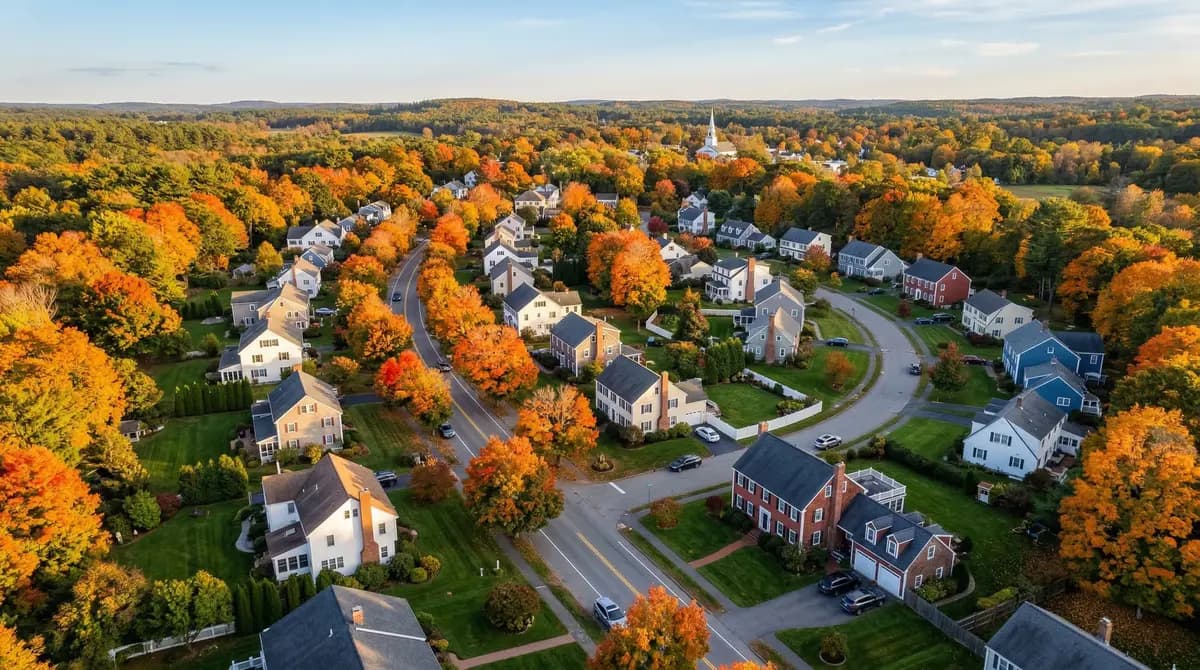
If you're researching moving to Easton, MA, the first thing to understand is that Easton doesn't fit the standard Boston-suburb template. This is a town built by shovel money — the Ames family ran their industrial empire from here in the 1800s and left behind a village center designed by Henry Hobson Richardson and landscaped by Frederick Law Olmsted. It's also a town where a 1,843-acre state park sits ten minutes from the high school, and where the biggest infrastructure question of the next decade is whether commuter rail finally arrives.
This guide covers what actually matters when you're relocating: how the two halves of town differ, what homes really cost, how the schools are structured, what the commute looks like today (not in a brochure), and who tends to be happiest here. No sales pitch — just the information I'd give a friend moving from out of state.
The two Eastons: North Easton village vs. South Easton
Easton is one town with two distinct personalities, and knowing the difference will save you a lot of wasted showings. North Easton is the historic village: five buildings designed by H.H. Richardson, Olmsted landscapes, the Ames Free Library, and streets lined with Victorian and Colonial-era homes, including some converted carriage houses. If you want to walk to a library, a coffee shop, and a landmark district, this is the pocket you're looking at — and you'll pay a premium for the character.
South Easton is quieter and more spread out. You'll find more land, more newer construction, and generally more value per square foot, with the town's southern edge running toward Sharon and the Borderland State Park corridor. Most of the town's everyday retail sits along the Route 138 corridor on this side. Plenty of relocating buyers start their search insisting on the village and end up in South Easton once they see what the same budget buys — a few minutes of driving in exchange for a bigger lot is a trade many buyers are glad to make.
Housing market reality check
Heading into 2026, average home values in Easton are running near $680,000, and inventory remains tight — a condition that describes most of southeastern Massachusetts right now. Well-priced single-family homes typically go under agreement within about three weeks, so if you're relocating on a timeline, plan to be pre-approved and ready to move before you start touring. Move-in-ready homes get the competition; properties needing updates give patient buyers a little more room to negotiate.
Where your money goes furthest depends on which Easton you choose. Historic homes near the North Easton village center carry a premium for their architecture and walkability, while South Easton offers more competitive pricing and more recent construction. Condominiums and townhomes provide lower entry points on both sides of town. One more long-term factor worth knowing: the state's South Coast Rail planning includes proposed stations at North Easton and Easton Village. Nothing is running yet, but if that project advances, it changes the calculus for a town that currently has no rail stop of its own. You can browse current Easton listings to see what's actually on the market at each price point.
Schools: one district, four schools
Easton Public Schools operates four schools: Blanche A. Ames Elementary, Richardson Olmsted School, Easton Middle School and Oliver Ames High School. The state counts 3,297 students in the district for 2025-26, with a student-to-teacher ratio of 13.9 to 1. Test results and graduation rates for each school are on the state's School and District Profiles site.
The town's commitment to education isn't new marketing — it goes back to the Ames family, who helped make Easton the second Massachusetts community to offer public kindergarten, back in the 1880s. Stonehill College, on the eastern side of town, adds another layer: a private college campus that contributes open space, events, and a steady, quiet presence rather than a party-school atmosphere.
Commuting from Easton
Here's the honest version. Easton sits roughly 30 miles south of Boston, and today it is a driving town. Route 24 runs along the town's edge and connects north to I-93 and the Southeast Expressway; Route 138 runs through town and links to both Route 24 and I-495. Heading the other direction, Providence is roughly 35–45 minutes by car — worth knowing if your household splits jobs between the two cities.
There is no commuter rail station in Easton right now. Train commuters drive to Stoughton or Mansfield, both on the MBTA's Providence/Stoughton Line, where the ride to South Station runs approximately 30–38 minutes. Factor the drive to the station and parking into your real door-to-door time. The long-term story is the South Coast Rail project, which includes proposed stations at North Easton and Easton Village — a genuine potential upgrade, but one to treat as a future possibility rather than something to count on for your first year here.
Daily life: Borderland, the village, and Stonehill
Borderland State Park is the anchor of outdoor life here — 1,843 acres straddling Easton and Sharon, with more than 20 miles of trails for hiking, mountain biking, and horseback riding, a historic mansion open for tours, and ponds for fishing and non-motorized boating. It's the kind of amenity most suburbs simply don't have. Beyond Borderland, the town maintains its own network of walking and biking routes that connect neighborhoods to the village center.
Day to day, life orbits two poles. North Easton village supplies the character — the Ames Free Library and the Richardson buildings still anchor community life, alongside local dining spots. The Route 138 corridor handles the practical errands, with larger retail in surrounding towns. Stonehill College fills in the rest: campus events, lectures, and green space that's woven into the east side of town. If you're picturing nightlife, this isn't that town — evenings here trend toward youth sports, trail time, and dinner in the village.
Who Easton fits best
Easton tends to work best if you put outdoor access and lot size ahead of walk-to-everything convenience: you want either historic character or newer construction on real acreage, and you don't mind driving to a train or taking Route 24. The proposed rail stations give it a longer-term appeal for buyers thinking about resale value five to ten years out.
It's a weaker fit if you need to walk to a train platform today, want dense restaurant-and-bar energy, or are hunting for the cheapest entry point in the region — nearby towns offer lower price tags, though usually without Easton's park acreage. If you're weighing Easton against its neighbors, the full Easton community guide breaks down the town side by side with the rest of the area.
I live and work in this market — my office is at 159 Belmont St in South Easton — and a good chunk of my buyers each year are relocating from out of the area, so walking newcomers through the North-vs-South Easton decision is a regular part of the job. If you want a straight answer about whether Easton fits your budget, commute, and timeline, reach out here or call me at (617) 949-1046. Jessica Shauffer, Coldwell Banker Realty, Weinstein Keach Group.
Ready to Make a Move?
Jessica Shauffer is a top Coldwell Banker agent serving Easton, Attleboro, Mansfield, and 22 other South Shore communities. Get a free consultation today.